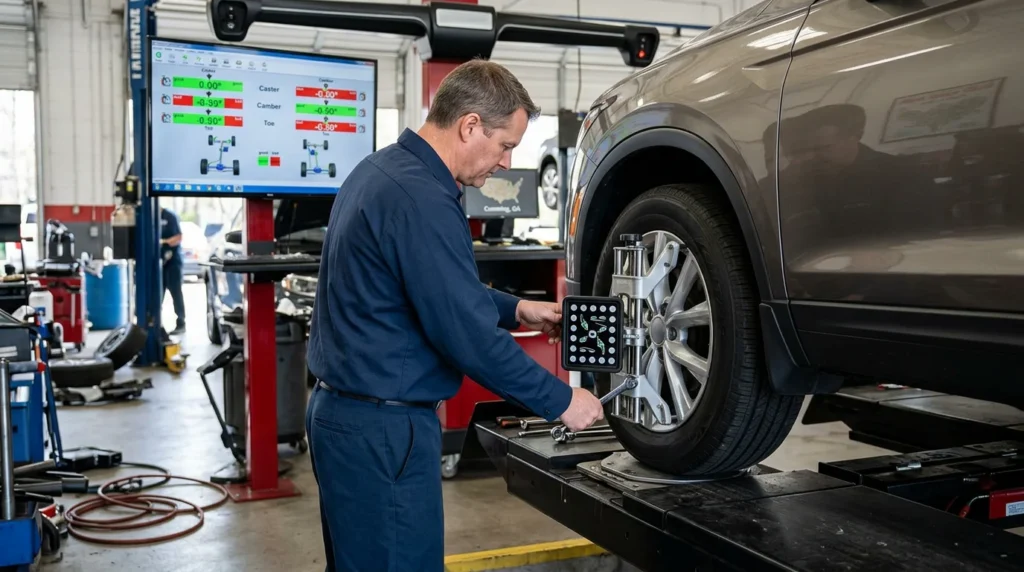
Quick answer: You likely need a wheel alignment if your car pulls to one side, the steering wheel sits off-center when driving straight, or your tires show uneven wear like bald edges or feathering. New tires won’t fix those issues if the angles are out of spec. Alignments are also smart after hitting a big pothole, curb, or after suspension/steering repairs to protect tire life and handling.
Signs Your Alignment Is Off
Misalignment usually shows up in how the car tracks and how the tires wear. If the vehicle drifts or pulls on a flat road, or you have to keep correcting the steering to stay in your lane, the wheels may not be pointed where they should be. Another classic clue is a steering wheel that’s noticeably off-center even though you’re driving straight.
Tire wear patterns are often the most expensive hint. Look for one shoulder wearing faster than the other, cupping/scalloping, or a “feathered” feel when you run your hand across the tread. If you’re seeing those symptoms and you’re searching for wheel alignment cumming ga, it’s a good time to schedule a check before you burn through another set of tires. Impacts from potholes, curbs, or rough construction patches can knock angles out of spec anywhere, so the trigger is the hit or the symptoms—not the zip code.
Don’t confuse vibration with alignment. A shake at certain speeds is more often tire balance, a bent wheel, or a worn suspension part. An alignment can’t fix a tire with a broken belt or a wheel that’s out of round, but a good shop will check for those problems before trying to “align around” them.
Alignment vs. New Tires: What Fixes What
New tires solve problems caused by worn-out rubber: low tread depth, cracking/dry rot, puncture repairs that won’t hold, or age-related hardening. As general guidance, many states consider 2/32″ tread depth the legal minimum, and many drivers choose to replace earlier (often around 4/32″) for better wet-weather traction. New tires do not correct the wheel angles that caused the wear in the first place.
An alignment corrects three main angles: toe (whether the tires point slightly in or out), camber (tilt in/out at the top), and caster (steering axis angle that affects stability and return-to-center). Toe issues commonly create feathered edges; camber issues often wear the inside or outside shoulder; caster differences can contribute to pulling. If parts are worn—like tie rod ends, ball joints, or control arm bushings—those must be fixed first or the alignment won’t hold.
Quick Decision Flow for Common Symptoms
Use this as a practical next-step checklist:
- Buying new tires: Replace tires first, then get an alignment check so the new tread wears evenly.
- Car pulls and you see uneven wear: Inspect steering/suspension for looseness or damage, repair as needed, then align.
- Steering wheel is off-center but the car doesn’t shake: Schedule an alignment check; toe is a common culprit.
- Vibration at highway speeds: Start with tire balance and a wheel/tire inspection; align only if wear/handling symptoms point that way.
- After a pothole/curb hit: Check for a bent wheel or sidewall bubble; if it drives differently afterward, get an alignment measurement.
When to Get an Alignment Checked and What to Expect
A practical rule is to have alignment checked after a significant impact (pothole, curb), after suspension or steering work, or anytime you notice new pulling or uneven wear. As general guidance, many drivers also do an alignment check about once a year or every 10,000–15,000 miles, especially if roads are rough or the car sees a lot of highway time.
Expect the shop to road-test, inspect steering and suspension for play, set tire pressures, then measure before-and-after angles on an alignment rack. Some vehicles allow adjustment of only certain angles from the factory; others may need additional hardware (like camber bolts) if you want more adjustability. If the tech says the car can’t be brought into spec, ask which parts or limitations are preventing it.
If you want help diagnosing tire wear, pulling, or steering feel, schedule an alignment inspection with Team Ryan Automotive.