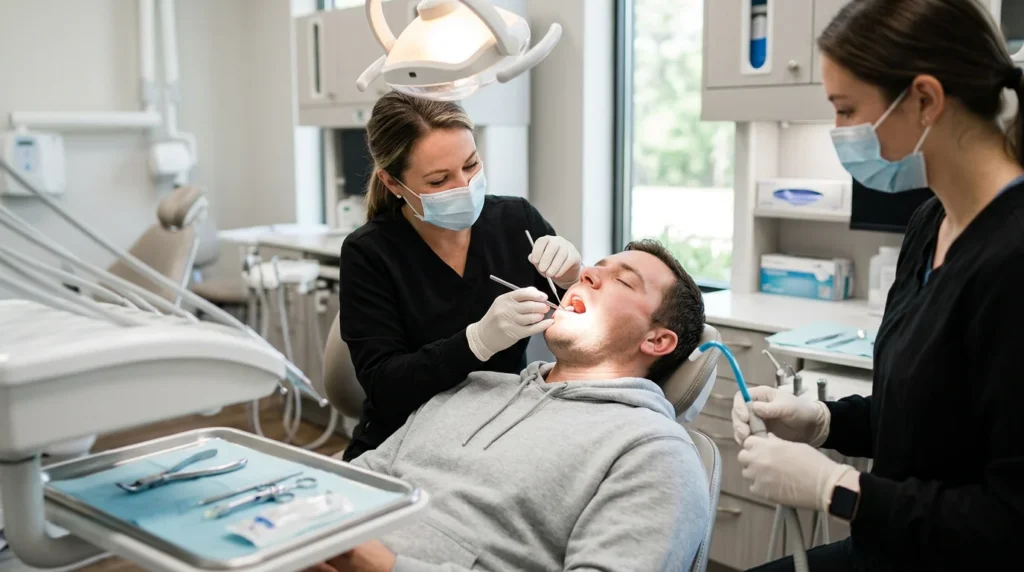
Quick answer: You likely need an emergency dentist the same day for severe, escalating tooth pain, facial swelling, a knocked-out or loose adult tooth, a broken tooth with sharp edges or nerve exposure, or signs of infection like pus and a bad taste. Medical red flags like trouble breathing, trouble swallowing, uncontrolled bleeding, or major facial trauma should be treated as ER emergencies first.
Fast Signs You Should Call Today
Call 911 / go to the ER now (medical emergencies): Trouble breathing or swallowing, rapidly spreading swelling of the face/neck, uncontrolled bleeding you can’t stop with firm pressure, or significant facial trauma (possible broken bones or airway risk). These are medical emergencies; dental offices are not the right first stop.
Emergency today (dental emergencies): Severe tooth pain that wakes you up, swelling in your cheek or jaw, fever paired with dental pain, a loose adult tooth after an injury, or a broken tooth with sharp edges or intense sensitivity can all need same-day care. Swelling can mean an infection, and waiting can make treatment more complicated.
Trauma is another clear trigger. If an adult tooth is knocked out, minutes matter—gently rinse it without scrubbing the root. Don’t force it back in if you’re unsure or it won’t slide in easily; keep it moist in milk or saline and seek immediate care. A cracked or broken tooth counts as an emergency if there’s sharp edge risk, exposed nerve pain, or the tooth is loose. For local help, you can reach a watkinsville ga emergency dentist to triage what’s happening and tell you what to do on the way.
Some problems feel minor but still deserve a prompt call: a “pimple” on the gum, a bad taste that keeps returning, or a tooth that suddenly feels taller when you bite. Those can point to an abscess or a bite issue that can crack a tooth further if ignored.
Quick Decision Tree: Emergency Today vs Urgent vs Can Wait
Emergency today (same-day care):
- Facial swelling, especially if it’s increasing or you feel sick (fever, chills).
- Knocked-out, very loose, or displaced adult tooth after an accident.
- Broken tooth with sharp edges, heavy pain, or possible nerve exposure (deep red/pink center).
- Uncontrolled dental pain that doesn’t improve with appropriate OTC medicine.
Urgent (within 24–48 hours):
- Lost filling/crown with sensitivity but manageable pain.
- Cracked tooth with intermittent pain when biting or temperature changes.
- Gum boil, draining taste/odor, or localized swelling without fever.
- Tooth that feels “high” or your bite suddenly changed, but you can still eat soft foods.
Can usually wait (schedule soon, protect the area):
- Small chip with no pain and no sharp edge cutting your tongue/cheek.
- Mild cold sensitivity that’s not worsening and no swelling.
- Food stuck between teeth that floss can remove without bleeding.
What to Do Before You’re Seen
For pain, use cold compresses on the outside of your face in short intervals. Keep your head elevated when lying down. Avoid placing aspirin directly on gums or a tooth—it can burn tissue. If you can take OTC pain medicine, follow the label and avoid doubling up similar ingredients.
For a cracked or broken tooth, rinse gently with warm salt water and cover sharp edges with orthodontic wax if you have it. Avoid chewing on that side.
For a knocked-out adult tooth, handle it by the crown (the chewing surface), not the root. If it’s dirty, rinse briefly with clean water—don’t scrub. If you’re confident it will go in easily, you can try to place it back in the socket; don’t force reinsertion. If you can’t reinsert it safely, keep it moist in milk or saline (or tucked in the cheek only if the person is alert and old enough not to swallow it) and get seen immediately. A quick response improves the chance of saving the tooth, but no method guarantees it.
What an Emergency Dental Visit Usually Includes
Most emergency visits start with targeted questions (what triggered it, pain level, swelling, fever, bite changes) and a focused exam. X-rays are common to check for infection, fractures, or bone involvement, but they may be delayed or avoided in certain situations (for example, if you can’t tolerate positioning due to pain, or if imaging would be better done after swelling is controlled). Photos and simple bite tests may be used instead.
“Temporary” treatment usually means stabilizing the problem so you can function safely until a definitive fix is done. That can include a temporary filling to seal an open cavity, a temporary crown to cover a broken tooth, smoothing a sharp edge, or placing a medicated dressing. Temporaries are meant to buy time; they can loosen or wear down, so follow-up matters.
Root canal treatment vs extraction is typically decided by how restorable the tooth is and what the X-ray/exam shows. Teeth with deep cracks into the root, severe bone loss, or too little healthy tooth left to support a crown are more likely to need extraction. Teeth with inflamed or infected pulp but solid structure are often candidates for root canal therapy. If infection is present, antibiotics may be used as support, but they don’t remove the source by themselves; the tooth usually still needs definitive treatment. General guidance on dental trauma and urgent dental problems is also summarized by the American Dental Association.
If you’re not sure how serious your symptoms are, call and describe the pain level, swelling, any fever, and what triggered it (injury, biting something hard, old filling). TLC Dental Wellness is a local place to get help sorting out what’s urgent and what can be scheduled safely.